

‘..and did you know that 9 out of 10 businesses fail?’ This statement is published as fact in countless websites. You may have even heard speakers source it as the truth. Sometimes the quote may even add a time frame such as ‘9 out of 10 businesses fail in the first 2 years’. Other variations include ‘8 out of 10 fail in the first 3 years’. Whatever the numbers, they always shine a bright light on the risk small business owner’s face.
It’s scary. When I first heard it I bit my bottom lip.
Rest assured, the statistics are only a myth. They have no reliable source. In fact they have no source at all. Three separate research groups investigated the claims and found them to be a gross exaggeration of fact. These academic groups found the true small business failure rate to be much lower. Consider their findings below:
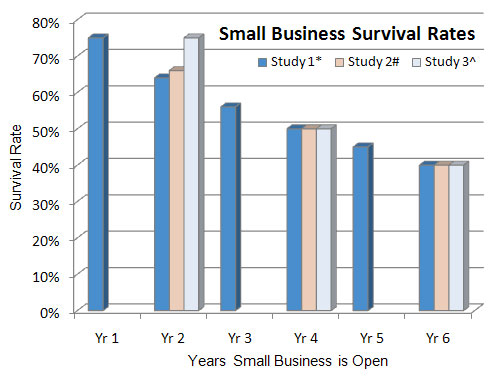
* Headd, B. Redefining Business Success: Distinguishing Between Closure and Failure, 2002
# Shane, S. Startup Failure Rates – The Real Numbers, 2008
< Phillips & Kirchhoff. Small Business: Critical Perspectives 1989
As shown above, the results of all three studies have a strong correlation. The studies agreed that at the 4 year mark, 50% of small businesses were still open and trading. By year six, the success rate had fallen to 40%.
Every Small Business That Closes is a Failure
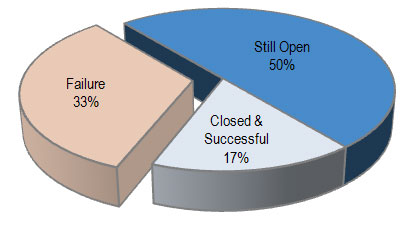
Not quite. While further examining the numbers, it became evident that a closed business did not necessarily mean a failed small business. The pie chart below puts this into perspective.
Not Every Small Business Closes Due to Performance
It shows that at the 4 year mark:
- 50% of small businesses are still open
- 33% of small businesses have closed due to performance
- 17% of small businesses have closed for non-performance reasons
Therefore, counting all closed small businesses as unsuccessful is incorrect. A total of 17% of businesses were found to have closed for non performance reasons such as choice, retirement or being bought. These businesses ventures should not be classed as failures.
What is the True Small Business Failure Rate?
Taking the three studies into consideration, the business failure rate is closer to 33% within the first 4 years. This is a far cry from the purported 90% within the first 2 years. Researcher Brian Headd put it best with his comment:
“These results suggest that potential entrepreneurs, particularly those planning very small ventures, have less to fear than is commonly believed.”
So get out there and go for it! Super charge your small business.
GET FREE INSTANT ACCESS TO THESE
THREE ESSENTIAL SMALL BUSINESS RESOURCES
(To help you maximise your business)

15 Recommended Downloads for Small Business Owners

10 Website Mistakes That Cost You Sales

How to Get More Customers Contacting You Automatically
Hi David
Those stats do seem to change at every seminar I go to… Thanks for the atypical, not all doom and gloom, message about small business failure. Hey, “Small Business Success Rate” – how’s that for a discussion topic?
I like your work, David. It is clear that some “small” business become much smaller than they planned, while a good healthy attitude can be a life saver.
.-= Sean Rasmussen´s last blog ..A Fistful Of Dollars =-.
Interesting read David – for too long we’ve heard the small business failure rate line. As Lina put it, it’d be nice to hear some positive information regarding small businesses. It makes you wonder who’s behind these statistics – multinationals perhaps, scared of competition from the little man?
Colin
Hi David,
My current blog is my third business. I read all those stats about failure rate when I started my first business. Yes, we did the hard yards and I think most people go into business and end up “in” it rather than working “on” it. Having said that, working ON the business rather than IN it is a hard thing if you do not have the right staff for delegation.
As Colin says…you do have to wonder who produces the 90% failure rate stats.
Thanks for providing a more realistic view. I enjoyed the read.
Regards, Eileen.
.-= Eileen´s last blog ..Food colors =-.
Thanks Lina, Sean, Colin & Eileen. Yes, those often quoted statistics have no basis in fact, which is very reassuring. I tend to believe that the people quoting these statistics do so to create a bit of a tense environment, so you’re more inclined to to listen to their advice.
Good article David. The tech industry would be in very serious trouble if 9 out of 10 start ups were failures! I think if you’re afraid to fail you shouldn’t even start a high-risk venture like a small business.
I particularly agree with your statement that not every business that closes is a failure. When I closed my first small business after only two years, we had broken even and were in fact turning a small profit. But we were taken over by Real World events – one partner moved overseas, and another had to stop work for medical reasons. We made a smart choice to cash in when we were all happy with what we’d achieved.
.-= Edward Brown´s last blog ..Securely manage your passwords with LastPass or KeePass =-.
Thanks Edward. Very true. It’s easy to perceive closing and failure to be the same thing. Once you dig a little deeper you find there’s a world of difference to the statistics.
This is a nice piece of work depending on the objective. Semantically, I would concur with the results. Reasonably, I would not, though would concur that 9 out of 10 failures may be wrong. How about phrasing the question in this manner, which, to me, is more at issue: How many businesses sustain after x years? You see, if I am a customer, there really isn’t much of a substitute for stability (if there is quality and good pricing inherent.) The lack of stability in small business, as in other factions of our lives, is NOT a good thing. It creates a lot of excess ‘spinning’, restart, etc…none of which bode well for ‘productivity’ (something the world views as important and we are grossly missing.)
So, while I’m glad we all ‘feel better’, the fact is the price of our good feelings is often not a very ‘effective’ way for us to grow a strong economy.
We are attacking the ‘wall street’ and government for not sustaining performance or growth over a period of hundreds of years. Where do they get their employees? And how long can we sustain on our own? Isn’t that the real question?
I am working hard to improve this sustainability, for us all, but we have to first quit using semantics to cover a real ‘issue’ for this country.
Hi David, Loved your article. It is really disappointing to hear all the time the scare tactics that a lot of business people and speakers use to suggest that most small businesses will fail. As your article has pointed out the numbers are a lot less than often projected and the failure rate of businesses is closer to 3/10, which is a lot more reassuring.
.-= Piano Lover´s last blog ..Piano Stairs =-.
I am working on a presentation about Lean principles for solo entrepreneurs. While seeking a source for the extremely high rate of startup businesses, I found your blog. Thanks for providing the source information for your statistics and graph. I don’t recall the high rate of failure ever referencing its source. Your information seems more credible.
Hi David. I was very interested in learning more about your study, especial in reference to the study (Global, U.S?). The methodology used to ascertain this figures is not clear. Kindly share more.
David, how spot on this is. While writing a similar piece for real estate, I was surprised to see how many sites throw stats around with no basis whatsoever…good for you for doing the homework! This is a great service to small businesses! Keep up the good work!
While statistics are extremely valuable, they are also notorious for being a means that people use to make false and misleading arguments. Taking into account survivorship bias, modelling errors, human errors, etc, I do not believe these statistics add any values to entrepreneurs. Just take a look at the failure rate of birth control pill from various sources. I guarantee you that the rates based off of researchers funded by pharmaceutical/medical companies will be significantly lower than the ones you would have seen from independent sources. As long as you’re aware of risks you’re undertaking and properly hedged against the risks, do not worry too much about stat.
Hi Jay. If you’re refuting the statistics, you need some sort of factual rather than conceptual rebuttal. And there doesn’t appear to be any surveyor bias in my quoted results, so your point about surveyors with a vested interest doesn’t hold up.
Great post and very passionate about the topic.
Its so disturbing to hear professional organizations formed to support SMB’s stating these “failure” percentages when they’re just not true. Your data is accurate and I believe the word “failure” is a ver big exaggeration. Most businesses that close even for “performance” aren’t failures.
What is failure…staying down and most don’t. Furthermore many of the businesses started each year of the 500,000+ are homebased businesses with very little invested in the business. If they close for “performance” the investment lost is little.
Many like to argue this stat, but lets knock it off and talk about solutions for success and encouragement to continue the entrepreneurial spirit that built our country.
Wishing all great Entrepreneurial Successes.
Thanks Mike. Totally agree. The failure statement needs a big fat asterisk. We also need to recognise that it’s essentially used to breed fear and therefore make people more susceptible to taking out the said product or service, least we become another statistic.